

Marketing is always changing. New platforms emerge, audience habits shift, and the tactics that worked a few years ago may not deliver the same results today. Artificial intelligence is speeding up that change, making it easier to create content, automate tasks, and generate ideas. Even as the tools and tactics evolve, the fundamentals of a strong marketing strategy remain the same.
Think of marketing like a road trip. You can fill the tank, pack the car, and take off with plenty of momentum. But without a destination, you’re just driving. You might cover a lot of ground, but you won’t necessarily get anywhere meaningful.
The same thing happens when businesses approach marketing without a clear direction. They publish content, run ads, update their websites, and experiment with new technology, but those activities don’t always add up to a larger result.
The Three Questions Every Marketing Strategy Needs to Answer
Technology changes, and your audience’s expectations may change. The questions at the center of your marketing strategy, however, are remarkably consistent.
1. Who Are You Trying to Reach?
Effective marketing starts with a clear picture of your audience. That means looking beyond broad categories like business owners, parents, donors, or decision-makers.
- What does your ideal customer care about?
- What are they trying to accomplish?
- What challenges are they facing?
- Where do they go for information, and what influences their decisions?
A more specific understanding of your audience helps you make better marketing decisions. It informs the topics you cover, the language you use, the platforms you prioritize, and the calls to action you present.

2. What Problem Are You Helping Them Solve?
People rarely seek out a business or organization simply because it offers a particular service. They’re looking for help with something.
Understanding that need should shape your marketing message. Rather than focusing exclusively on what you offer, explain the problem you help solve and why it matters to the people you’re trying to reach.
This is also where your content can become more useful. Blog posts, website pages, emails, and social media should address real questions and concerns your audience has. When your marketing speaks to something they’re already thinking about, it gives them a reason to pay attention.
3. Why Should They Choose You?
Your audience has options. What makes your organization the right choice?
Your answer might come from your experience, your approach, your expertise, the quality of your work, or the relationships you’ve built. It could be a combination of things that make your organization distinct.
Whatever sets you apart, your marketing needs to communicate it clearly and consistently.
This is where brand positioning and messaging come into play. Your website, social content, email campaigns, and other communications should reinforce the same central idea about who you are and the value you bring.
If your message sounds interchangeable with your competitors’, your audience has little reason to remember you.
The Customer Journey Is Changing. Your Strategy Should Account for It.
The fundamentals of marketing may be familiar, but the way people discover and evaluate organizations is changing.
A prospective customer might once have searched Google, clicked through several websites, compared services, and contacted a business directly. Today, that same person might ask an AI assistant for recommendations, read an AI-generated summary, and narrow their options before visiting a single website.
Your organization may be part of that decision-making process even if someone never lands on your homepage.
That’s where Answer Engine Optimization (AEO) comes in. AEO helps organize and strengthen your online content so search engines and AI-powered systems can better understand your organization, its expertise, and the questions it answers. It works alongside traditional Search Engine Optimization (SEO), which supports your visibility in conventional search results.
But technical optimization alone won’t give people a compelling reason to choose your organization. AI systems need clear information to understand what you offer, and potential customers need a clear message to understand why it matters to them.
What We’re Seeing in AI Search Audits
In a recent audit for a regional land trust, we found that AI platforms pulled information from its website more than 1,000 times over six months, using 219 different pages. But being a source didn’t always mean the organization received credit.
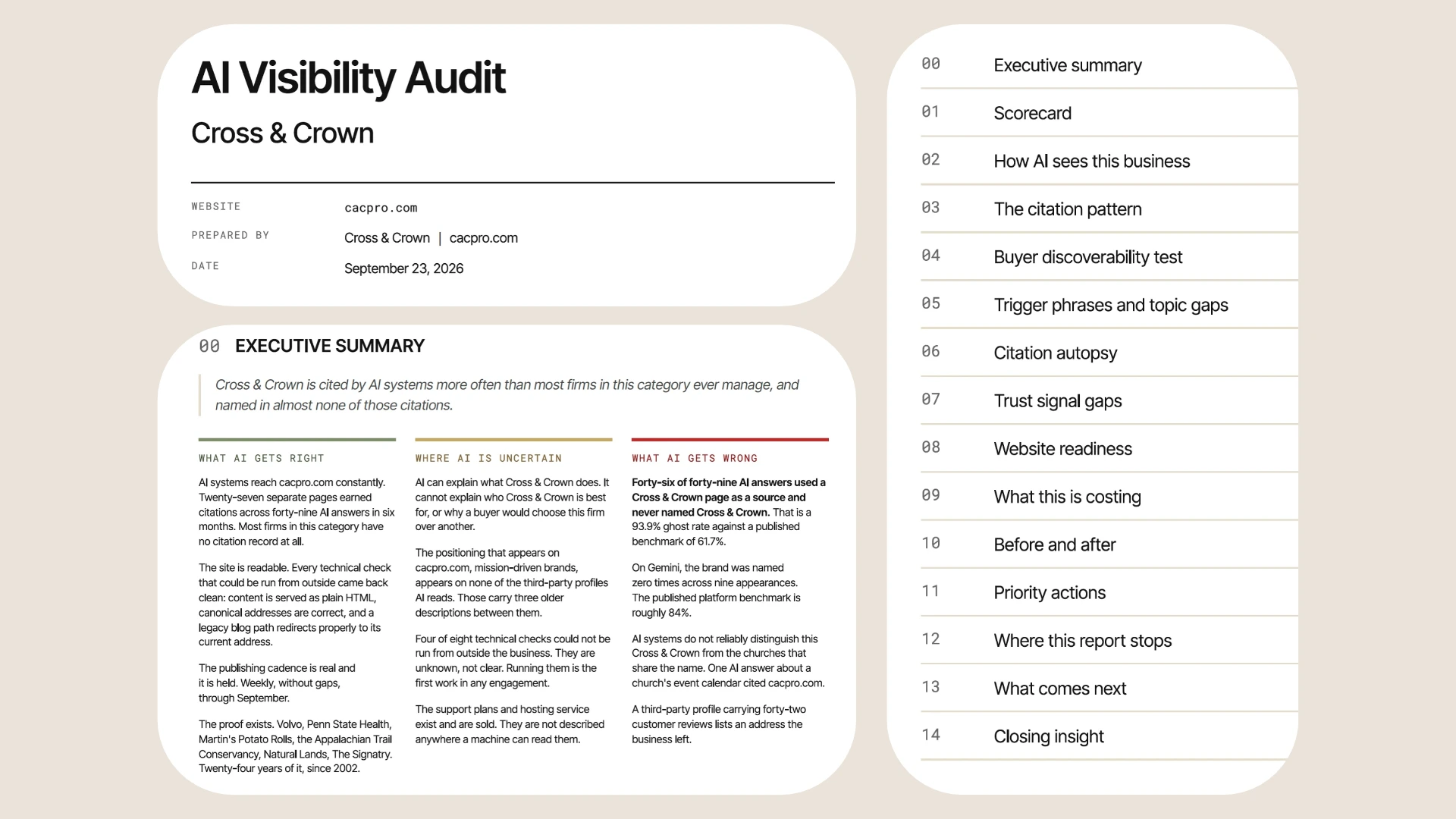
AI Uses Your Content Without Naming You
Across 153 of the 197 nature topics reviewed, AI used the land trust’s content without mentioning its name. Its most-cited page, an article about snakes, never identified the organization. A confusing sentence from that page also appeared in AI-generated answers, showing how errors in published content can carry over into AI responses.
When asked about trails in their home county, AI named the land trust 22 out of 25 times. Its specific, location-focused pages helped connect the organization to the places people wanted to visit.
Are You Visible for the Work You Do?
Only about 1.2% of the questions tracked were related to the land trust’s core work. Someone asking how to protect family farmland from development received no information about the organization, even though land conservation is central to its mission.
The audit also found conflicting information across the organization’s online records, including four different preserve counts and two acreage figures. Its accreditation appeared as a logo, which AI couldn’t read. Both issues made it harder for AI to build an accurate picture of the organization.
The same disconnect appeared in traditional search. Google impressions increased by 34%, while clicks fell by 4%. About six in ten of the land trust’s ranking keywords also triggered an AI overview, giving searchers answers without requiring a visit to the website.
The Takeaway
Look at those findings through the three questions above. The land trust’s most-cited content answered questions about snakes, while landowners asking how to protect family farmland, the exact problem the organization exists to solve, never saw its name. Its case for why to choose it sat inside a logo AI couldn’t read, surrounded by records that disagreed with each other. The AI platforms were doing their job. The gap was strategy, including who the content was written for, which problem it addressed, and how clearly the organization proved it was the right choice.
The key takeaway is that being used by AI is not the same as being named by AI.
How to Stand Out When Content Is Free
AI has made content production faster and more accessible. Businesses can generate articles, product descriptions, social posts, email campaigns, and website copy with relatively little effort.
Content has become nearly free, which makes sameness a significant risk to your brand. When every organization can publish on the same topics using similar tools, producing more content won’t necessarily give you an advantage.
Three things hold their value when content costs nothing:
- A point of view. Say what you believe and why. Take a position your audience can agree or disagree with. AI can summarize the average opinion, but your organization’s perspective comes from its experience, expertise, and values.
- Real proof. Your stories, projects, clients, data, and people are crucial. A model can’t replace the details of the work you’ve done or the relationships you’ve built. Sharing real examples gives your audience something concrete to connect with.
- A recognizable voice. Someone should know a sentence is yours before they see the logo. That takes a brand built with intention and a team willing to say no to the bland version.
Your content should sound like it comes from people who understand their work and the audiences they serve. AI can help with the production process, but your experience and perspective should shape the message.
Give Your Marketing a Direction That Can Last
At Cross & Crown, we bring branding, web design and development, and digital marketing together to help organizations build a cohesive presence and reach the people they want to serve. Our work in SEO, AEO, content strategy, and AI visibility helps clients understand how their audiences find them and identify opportunities to strengthen their marketing.
The tools will keep changing. Your audience may find you through a Google search today and an AI recommendation tomorrow. But the organizations people remember will still be the ones that understand their needs, communicate their value, and give them a reason to choose them.
Before your team fills the tank and hits the road, make sure you know where you’re headed. Connect with Cross & Crown to talk about your brand, your audience, and your marketing strategy.

Cross & Crown
Based in Chambersburg, PA, we build & refine brands that inspire trust, drive engagement, lead with purpose, and ensure a thriving future.
Last Update: November 9, 2026
Read More

November 2, 2026
Social Media Community Management: How Comments and DMs Become Customers
Social media community management helps businesses turn everyday interactions into stronger relationships. Learn how thoughtful replies, useful conversations, and consistent engagement can build trust and create opportunities for new customers.
Read Post
October 19, 2026
A/B Testing in B2B: The Marketing Experiment You’re Probably Not Running
A/B testing gives B2B marketers a practical way to learn what resonates with their audience. Explore how split testing can improve websites, campaigns, emails, and paid advertising while helping teams make smarter marketing decisions.
Read Post
October 12, 2026
The State of Marketing in the Age of AI
AI is changing how marketers work, from content creation and automation to personalization and campaign strategy. Here’s what we’re seeing, what we think is worth paying attention to, and why human strategy and creativity will continue to matter.
Read Post