

If you’ve ever tried to navigate search marketing, you’ve probably asked yourself, what is the difference between SEO vs. SEM, and why does it matter? Many business owners treat them interchangeably or assume one can replace the other, but they play very different roles. SEO builds long-term visibility by helping search engines understand your content and authority, while SEM delivers immediate results through paid placements. Knowing how and when to use each can save time, budget, and frustration, and in most cases, the best results come from using them together.
What Is Search Engine Optimization (SEO)?
Search Engine Optimization (SEO) is the process of making your website and content more visible in organic search results. The goal is to show search engines that your content provides value, so they rank it on their results pages.
SEO works through:
- Optimizing your website’s structure and content
- Creating helpful, relevant, and targeted content
- Building authority and trust over time
Effective SEO improves long-term visibility, establishes credibility, and can lower cost per lead over time. It’s a strategy built for sustainable growth, where each piece of content compounds to reinforce your expertise and brand authority.
Read More: The Basics of SEO Marketing for Small Businesses
What Is Search Engine Marketing (SEM)?
Search Engine Marketing (SEM) uses paid ads to place your business at the top of search results instantly. Unlike SEO, SEM requires an ongoing budget to maintain visibility, but it can drive traffic and leads immediately.
SEM relies on:
- Keyword targeting
- Pay-per-click (PPC) bidding
- Campaign optimization and testing
The advantages of SEM are speed and precision. Ads put your business in front of the right audience right away, making them ideal for launching new products, supporting seasonal campaigns, or testing messaging. But without a clearly defined budget and strategy, SEM can quickly become expensive.
How SEO and SEM Overlap
While SEO and SEM operate differently, they share some core principles:
- Keyword research
- Understanding search intent
- Optimizing landing pages
- Conversion-focused content
Both channels require insight into what customers are searching for and why. The better you understand their intent, the more effective either approach will be.
Read More: Keywords 101: How to Create Content to Help Your Customers Find You Online
Key Differences Between SEO vs. SEM
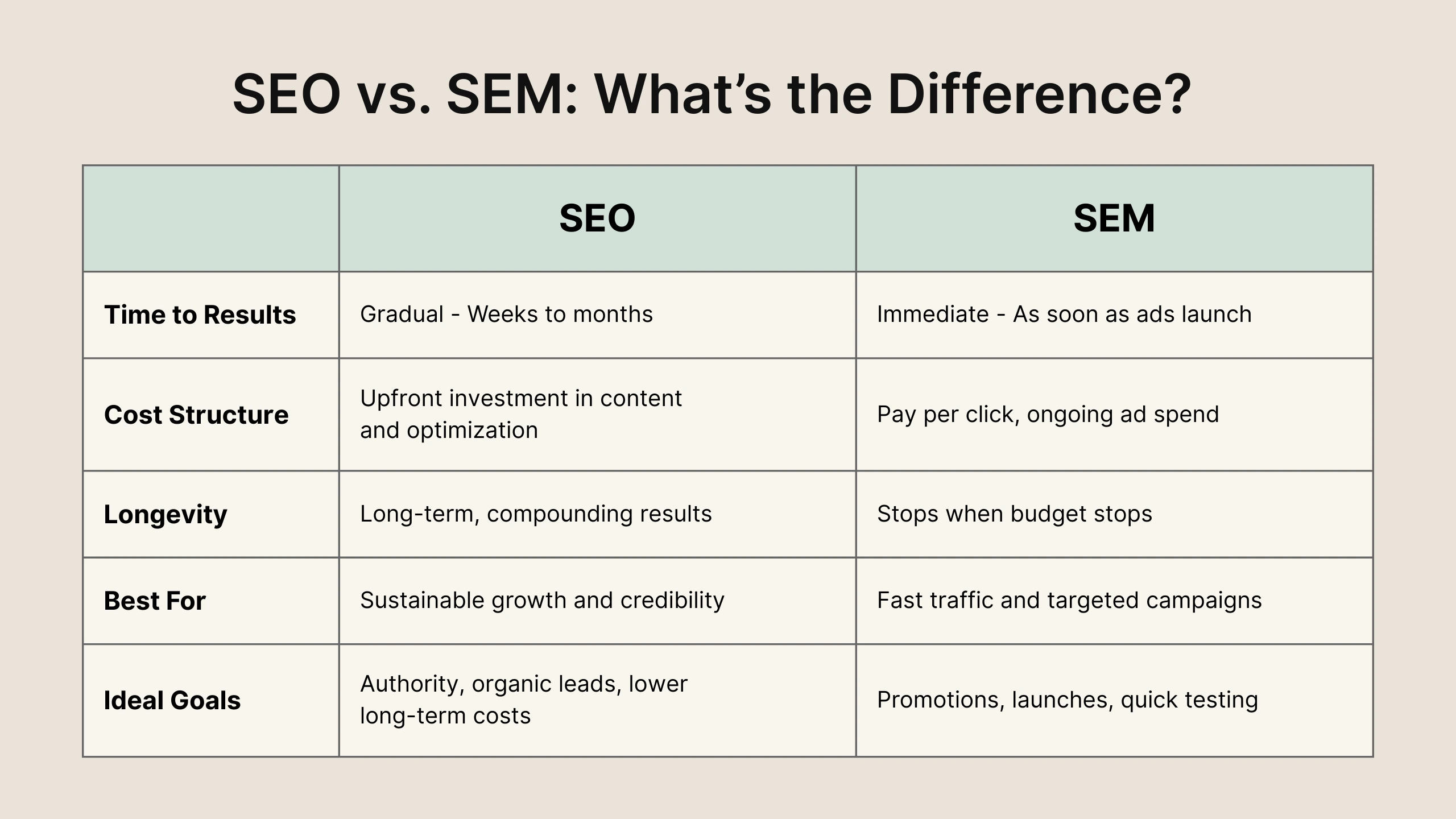
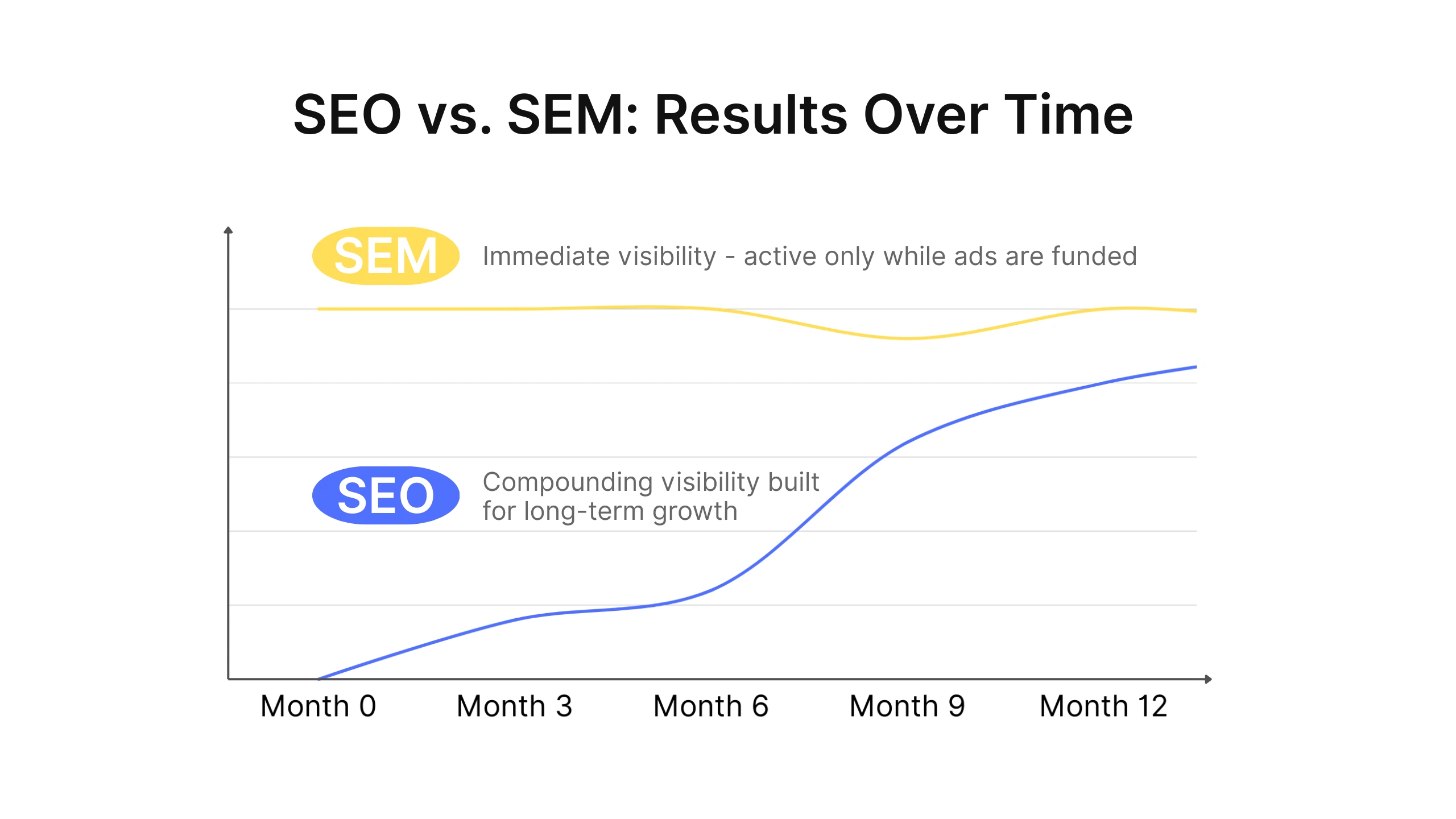
While SEO and SEM both aim to help your business show up in search results, they operate in fundamentally different ways. The biggest being that SEO is a long-term strategy. It relies on creating valuable content, structuring your website properly, and building authority over time. Results aren’t immediate, but once they start to come, they compound.
SEM, on the other hand, is about speed and precision. It allows you to appear at the top of search results instantly, but only for as long as you’re actively funding the ads.
SEM vs. SEO can be summed up in a few key areas:
- Cost structure: SEO is an upfront investment in strategy, content, and technical optimization, while SEM requires ongoing spending for each click your ad receives.
- Longevity: SEO builds a foundation that continues to generate leads and traffic over time. SEM delivers results only while your campaign is active.
- Time to results: SEO takes weeks or months to show measurable impact, whereas SEM can produce immediate visibility.
- Messaging control: SEM allows precise control of ad copy, but it’s temporary and tied to your budget. SEO gives you more flexibility, letting your website and content shape messaging consistently over time.
- Sustainability: SEO creates ongoing value and authority; SEM requires constant investment to maintain presence.
Understanding these distinctions helps clarify when each approach makes sense and sets the stage for deciding which strategy—or combination—best aligns with your business goals.
Read More: What is Holistic SEO? A Deep Dive into Integrated Marketing Strategies
When SEO Makes Sense for Your Business
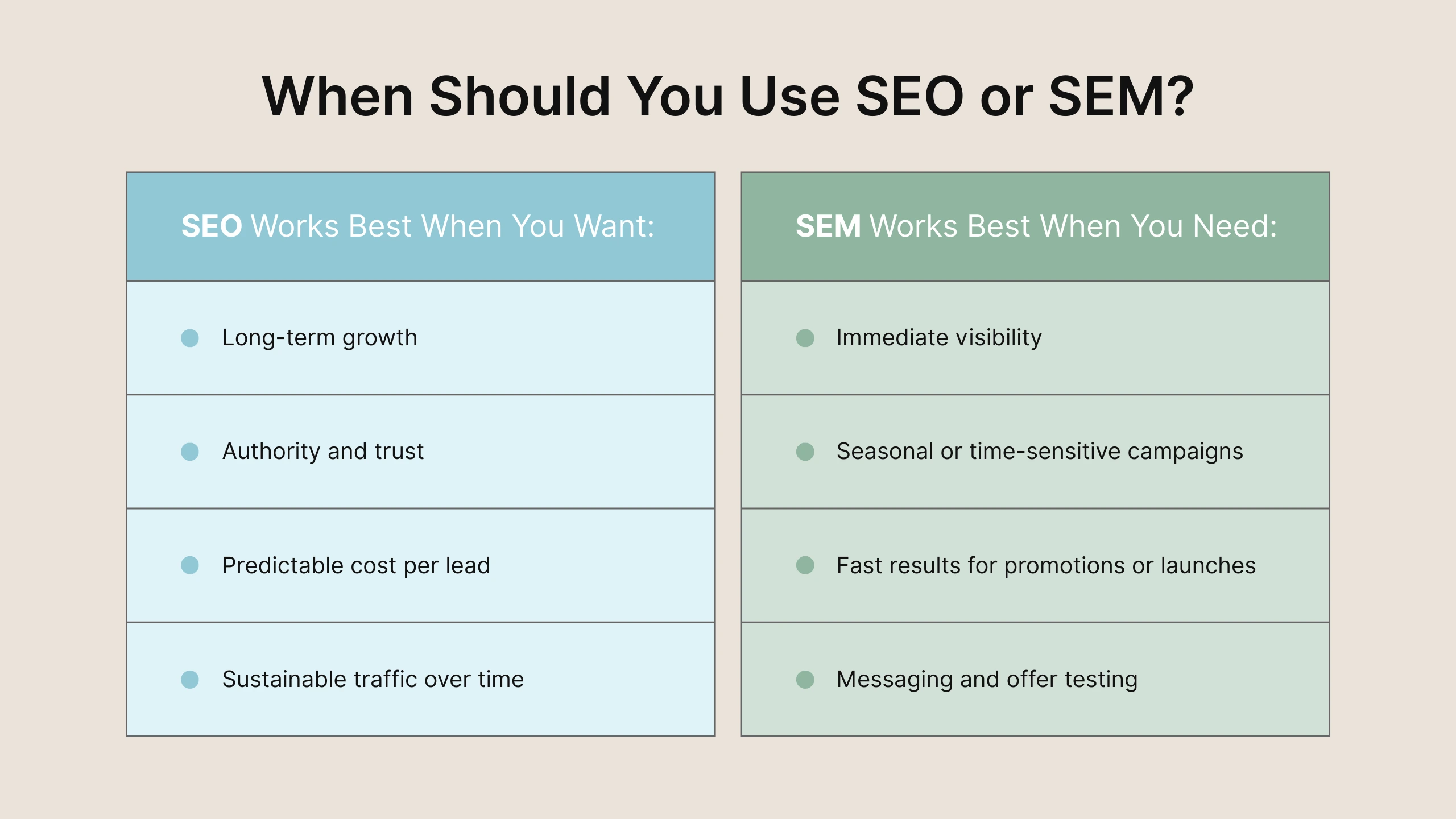
SEO is most valuable for businesses focused on long-term growth and authority. If your goal is sustainable traffic, building trust, and establishing your business as an expert in your field, SEO provides the foundation. This is especially true for industries with longer sales cycles, where potential clients need multiple touchpoints before making a decision. A professional services firm, for example, benefits from SEO by creating educational content that demonstrates expertise, builds credibility, and nurtures leads over time.
Investing in SEO also helps reduce reliance on paid channels in the long run. Once your pages are ranking well, the traffic they generate is essentially free, making your overall cost per lead more predictable and manageable. The key is patience: SEO is about steady, compounding growth rather than immediate gratification.
When SEM Makes Sense for Your Business
SEM excels when speed matters. If your business needs immediate visibility, SEM can put you at the top of search results the day your campaign launches. It’s particularly effective for new products, seasonal promotions, or campaigns where timing is critical. Unlike SEO, SEM allows you to test messaging, offers, and keywords in real time, giving you rapid feedback on what resonates with your audience.
The trade-off is that SEM is only effective while your campaign is running. A well-crafted ad can drive traffic and leads immediately, but the moment the budget runs out, visibility disappears. This makes SEM most effective when used strategically—either alongside SEO or as a tactical solution to meet short-term goals.
Read More: 6 Reasons Why Digital Marketing Web Design Matters
So… Do You Need SEO, SEM, or Both?
Ultimately, it’s not a matter of choosing one over the other. The right approach depends on your business goals, timing, and resources. Combining SEO and SEM increases your search presence, giving your business multiple touchpoints in search results. This dual approach supports more consistent lead generation and helps your brand maintain visibility even as algorithms and search behavior evolve. When implemented thoughtfully, this integrated strategy creates a more resilient and sustainable foundation for growth.
Search marketing works best when strategy guides tactics. At Cross & Crown, we help businesses develop a cohesive approach, integrating SEO and SEM to maximize both visibility and performance. Whether you need leads today or steady growth over time, a balanced strategy ensures every effort contributes to measurable results.

Cross & Crown
Based in Chambersburg, PA, we build & refine brands that inspire trust, drive engagement, lead with purpose, and ensure a thriving future.
Last Update: March 5, 2026
Read More

October 19, 2026
A/B Testing in B2B: The Marketing Experiment You’re Probably Not Running
A/B testing gives B2B marketers a practical way to learn what resonates with their audience. Explore how split testing can improve websites, campaigns, emails, and paid advertising while helping teams make smarter marketing decisions.
Read Post
October 12, 2026
The State of Marketing in the Age of AI
AI is changing how marketers work, from content creation and automation to personalization and campaign strategy. Here’s what we’re seeing, what we think is worth paying attention to, and why human strategy and creativity will continue to matter.
Read Post
October 5, 2026
How to Market a Church Without Compromising Your Mission
Church marketing can feel at odds with a church’s mission, but thoughtful communication can help more people find and connect with the ministry already happening in their community. Here’s how to market a church with clarity, authenticity, and a focus on serving people well.
Read Post